Script dialogue: if your characters are just talking you're doing it wrong.
When it comes to how to write great dialogue in a script, most advice tends to be quite vague. For example, you'll often hear how “script dialogue should…”
• “Propel the story forward”
• “Reveal character and theme”
• “Build conflict and drama”
• “Sound different for each character”
• “Entertain with witty, quotable lines”
• “Never run longer than three lines”
• “Never be on-the-nose”
The first problem here is that, while much of this advice is true, it doesn’t really get to the heart of the problem behind 90 percent of bad screenplay dialogue.
Or how to fix it.
It tells writers to do something specific, like add more conflict or subtext, without looking at the bigger picture that’s causing the lack of conflict or subtext.
Similarly, when writers are told to build conflict, push the story forward and reveal character through dialogue, this encourages the act of writing more dialogue. But this is the heart of the problem: letting characters coast through easy-going conversations.
Click to tweet this post.
The biggest problem with dialogue in spec scripts: “shooting the breeze.”
Many screenwriters fall in love with writing dialogue—letting their characters loose to just talk and talk and talk because, well, they have a lot to say. In reality, the skill in writing great script dialogue is knowing when and how to shut characters up.
As you’ve probably heard before, every line of dialogue in a screenplay should be in there for a reason. If not it can be cut. However, this advice can be a tricky thing to adhere to because writers often approach script dialogue as characters “just talking.”
But it isn’t…
Rather, a script’s dialogue should nearly always put the characters under some kind of pressure.
A character’s words should be either hard to say or hard to hear.
What we often see in spec screenplays, however, is the opposite: words that are easy to say and easy to hear.
When characters are continually left to “shoot the breeze” like this—chat in a friendly manner with no real purpose or conflict—the reader loses interest. Often not only in the scene, but in the whole script.
It’s okay to have characters begin a scene by talking in a relaxed, friendly manner, engage in small-talk, order food, etc. But if they continue to talk like this for the entire scene—as in the dialogue examples coming up—then you have a conversation that's “just talking” rather than pushing the story forward.
A script dialogue audit.
Rather than just being told what your script dialogue should or shouldn’t do, we’ve come up with an exercise that should help you see the problem more clearly in your own screenplay.
And the way to do this is to first see dialogue examples of it in another writer’s. The exercise is divided into three parts:
• Read three examples from spec of “shooting the breeze” dialogue
• Discover the kind of fundamental questions you should ask yourself about the dialogue in a scene (which you’ll find after each dialogue example)
• Read your own script and apply the same questions to every conversation
Doing this will hopefully enable you to better identify the problem of chatty screenplay dialogue in your own work and then give you the tools to either rework the scene or cut it altogether.
Spec script dialogue example #1.
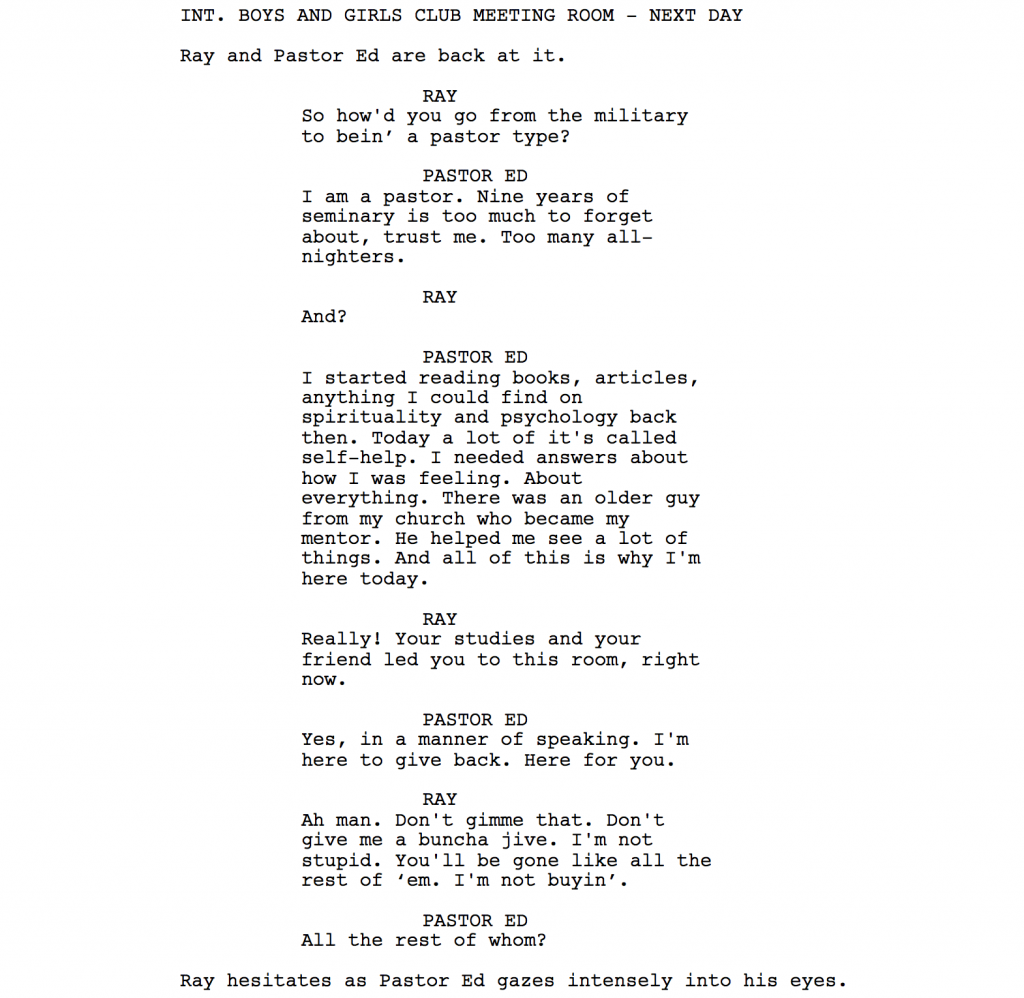

Now ask yourself the following five questions about the above script dialogue example:
1. Is this a hard conversation for one or both of these characters to have?
2. Does it put one or both of the characters under pressure?
3. Does the conversation involve conflict as one character tries to “win a battle”?
4. Were you engaged and excited while reading this screenplay dialogue?
5. Has a fundamental shift in the story occurred by the end of the scene?
The answer to each of these questions is no.
What's wrong with this dialogue?
Neither Pastor Ed or Ray are feeling particularly uncomfortable during this script dialogue. Despite addressing difficult subject matter, the tone is friendly and relaxed. Neither Pastor Ed or Ray are attempting to outwit the other in a “verbal battle”—back them into a corner, trick or intimidate, etc.
We have a post here on how to write dialogue between two characters that shows how to inject conflict into a conversation by equating it to a game of tennis.
Note also how both Pastor Ed and Ray’s dialogue also regularly strays over the recommended three lines maximum quota. Read screenplays and watch films, paying particular attention to how much each character actually says all at once.
You’ll find it’s really not much at all.
How to rectify this in your own script's dialogue.
Go through your own script and make a note of every scene containing dialogue that’s easy-going instead of emotionally charged.
Start with the obvious scenes that should involve verbal conflict but don’t, like the one above between a troubled young man and a pastor. Find these scenes by asking yourself similar questions to the ones above.
If you were in these characters’ shoes, how nervous would you be? How would you struggle during the conversation? How bad (or good) would you feel by the end?
If you’d feel okay then the script dialogue probably needs rewriting to include much more conflict and a “verbal battle” of some kind.

Spec script dialogue example #2.

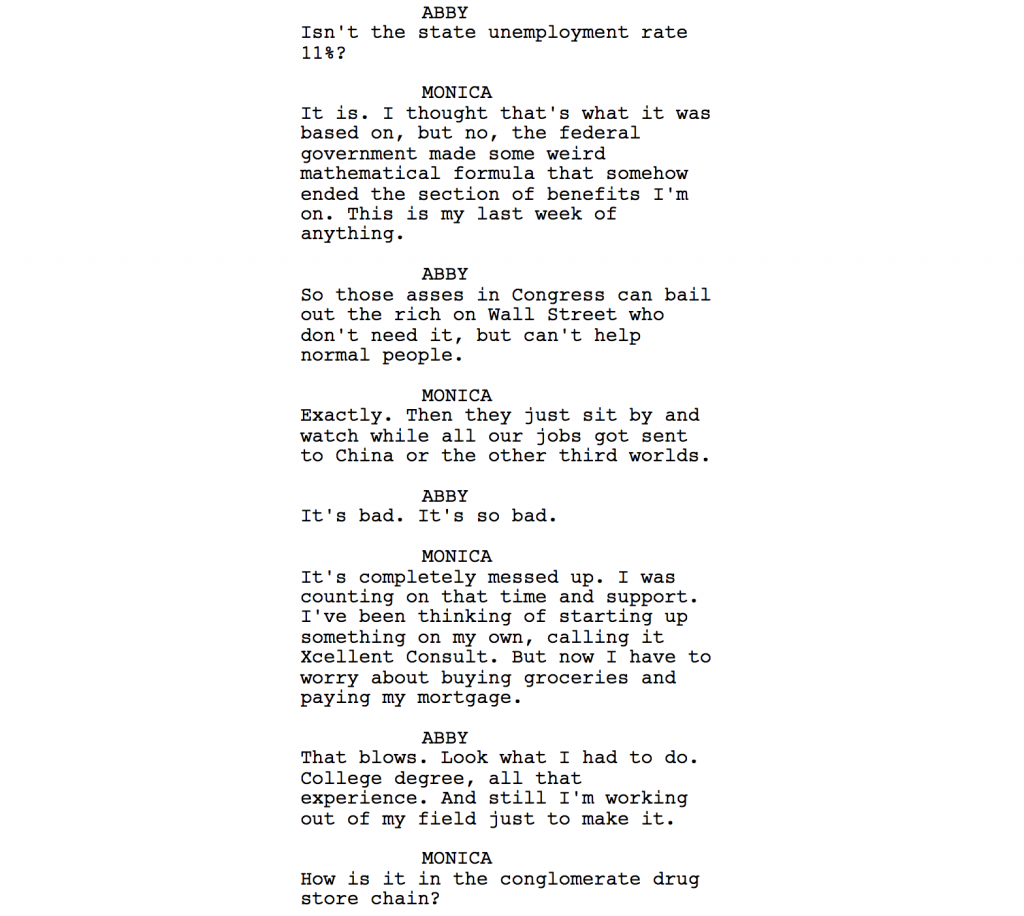

Now ask yourself these three questions about the script dialogue example above:
1. Is this an important conversation that deserves to be in the script?
2. Does this script dialogue interest, amuse or shock you in some way?
3. Does it feel like a natural conversation between two real people?
Again the answer to these questions is no as it’s another example of characters “shooting the breeze.”
What's wrong with this dialogue?
Abby and Monica don’t discuss anything particularly important to the story and nothing surprising is revealed at the end to push it forward.
Overall, they spend most of the conversation complaining about the job market, rather than actually putting the other under any kind of real pressure with their dialogue.
Note also the frequent use of questions. Abby asks Monica five questions in the scene:
1. “Any luck finding anything?”
2. “What happened?”
3. “What about the other one?”
4. “Isn’t the state unemployment rate 11%?”
5. “By the way, where’s your friend, Chloe?”
In addition, Monica asks Abby “How is it in the conglomerate drug store chain?”
This Q&A-style of script dialogue is very common in specs and is another symptom of letting characters “just talking” rather than forcing them to use their words as weapons.
When characters are continually asking each other questions like this, it feels unnatural and “on-the-nose” because this isn’t how people talk in real life.
As in the first scene, it’s hard to really imagine Abby and Monica as real flesh-and-blood people because they’re talking in such a direct, obvious way—asking each other straight-up questions for the benefit of the audience rather than themselves.
This also makes the script dialogue uninteresting to read as it feels like the writer is force-feeding us information. There’s no intrigue or surprise here as characters invariably end up answering these sort of questions exactly as we’d expect them to.
How to rectify this in your own script's dialogue.
Start by going through each scene in your screenplay and noting how many questions are being asked.
If the characters are engaged in a Q&A session, there’s a strong likelihood they’re just amiably chatting and their dialogue is purely for the audience’s benefit.
Seek out banal questions and answers and rework every conversation so the characters are making life difficult for themselves, hiding something, revealing something or engaging in an escalating war of words.
We understand that this can be hard to do as on the one hand screenplay dialogue needs to feel casual and “real,” just like how people talk in real life. On the other hand, dialogue isn’t how people talk in real life at all.
It’s a heightened reality in which characters hardly ever stumble over their words or go off-track, are much wittier than usual and always know just the right thing to say at just the right time.
When it comes to dialogue in a script, every word is selected for a reason, because they want to conceal something, find something out, kiss them, hurt them and so on.
The trick, then, is in making script dialogue feel like real life, but with every single conversation earning its place in the script. And the best indicator is: if the discussion isn’t making the characters uncomfortable or revealing something, it probably needs cutting.
Spec script dialogue example #3.
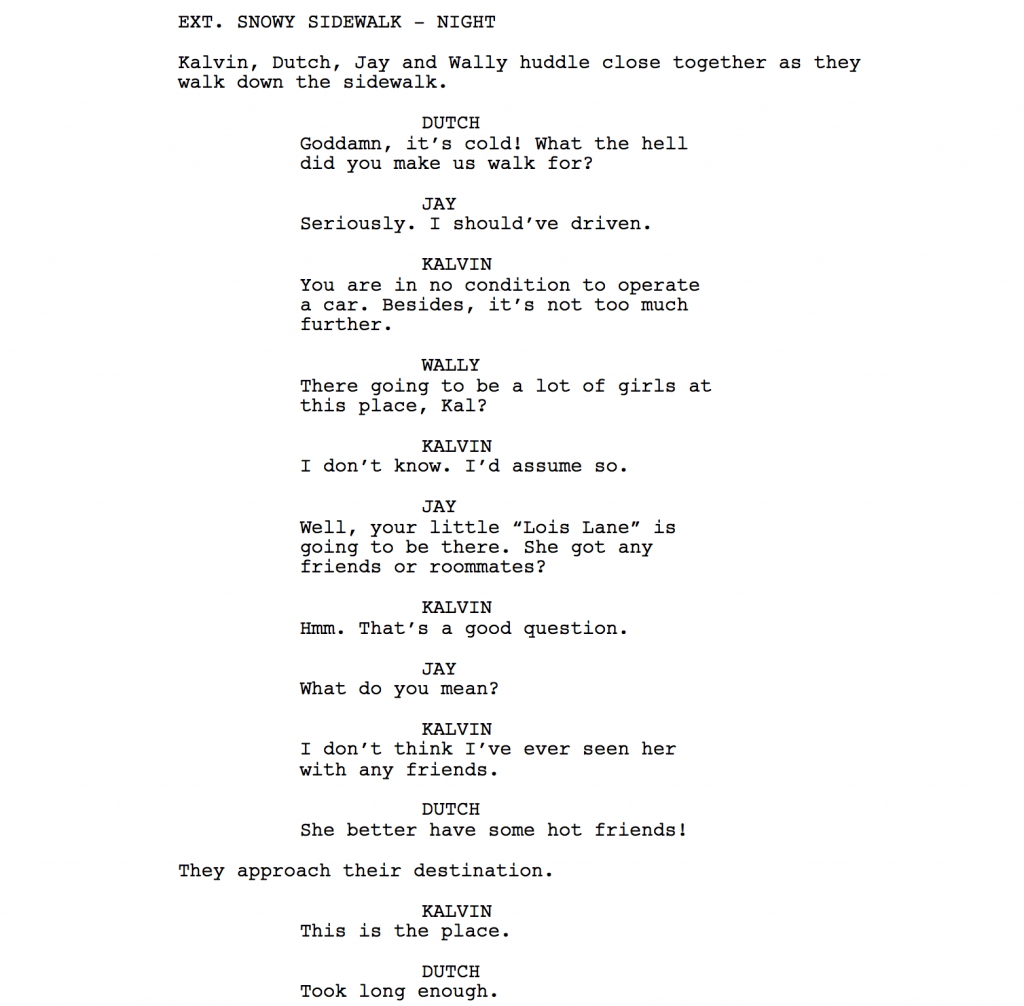


Here are the final set of three questions to ask yourself about this script dialogue example:
1. Is this a conversation you’ve never heard in a movie before?
2. Does each character have a distinct personality?
3. Does this conversation reveal anything new about these characters?
As you can see the answer again to these questions is no.
What's wrong with this dialogue?
This dialogue feels uninspiring and generic because yet again these guys are just “shooting the breeze.” The conversation never escalates into anything approaching conflict and, as a consequence, there’s no real reason for it to be in the script.
Note as well how there’s nothing particularly fresh or surprising about it. We feel like we’ve heard this kind of script dialogue a million times before and this is another major symptom of just letting characters chat without defining why they’re talking.
In real life, people have these kinds of inconsequential conversations all the time, but they don’t belong in a screenplay in which dialogue should be a heightened reality as previously discussed.
Finally, there’s nothing to differentiate these characters from each other. Kalvin kind of has his own voice, but you could swap out Jay’s name for Dutch’s and Wally’s name for Jay’s and nobody would notice.
How to rectify this in your own script's dialogue.
Go through your script highlighting one character’s dialogue at a time. Do they all sound the same? If so, it probably means you don’t know the characters as well as you could. But once you know them better, they’ll also begin to develop an individuality to the way they talk, what’s known as a “voice.”
Creating a “voice” with a character’s dialogue can definitely be tricky but it’s ultimately what makes them interesting: the way you show us who they are by how they talk and what they choose to talk about.
In Sex and the City, for example, we have four women who are all roughly the same age, live in the same city, come from similar backgrounds and all have good jobs, and yet each character’s dialogue has a “voice” because each one has a different worldview, attitude and outlook on life. And this comes out in what they choose to talk about and how they react to things.
Once you know your characters a little better in this way, then their dialogue will naturally begin to sound different because you will be able to write it according to their individual personalities.
Click to tweet this post.
Conclusion.
Writing easy-going “shooting the breeze” script dialogue is an easy trap to fall into. While there are no obvious glaring dialogue mistakes in these scenes and they’re competently written, this is actually half the problem.
It’s because this kind of genial, laid-back dialogue is so easy to write that it feels normal and safe and ends up becoming a default position for the whole script.
The trouble is, happy-go-lucky conversations are not particularly interesting to read and definitely not exciting to watch up on screen.
Another good way to eliminate screenplay dialogue that’s just “shooting the breeze” is to always remember that your characters’ speech should serve the needs of the scene, not the other way around.
In other words, script dialogue should not the be-all-and-end-all of a scene. It should be the last thing added to it—layered on top of the reason why the scene’s in the script in the first place—with stakes attached that relate back to the protagonist’s central dilemma.
The main purpose of a scene should be to push the story forward, from one beat to another. Therefore, the primary cause of bad script dialogue writing isn’t necessarily bad dialogue... It’s often a bad scene.
Maybe the scene itself needs work.
Great script dialogue depends on your characters being in an already great scene.
So if you want to know how to write good dialogue between your characters, the first step may be to take a look at your scenes and ramp up the stakes and conflict within them until there’s something emotionally interesting happening in each one—regardless of the dialogue.
If you can’t find a reason why, say, Abby and Monica’s conversation during a yoga class should be uncomfortable, difficult or revealing in some way, then it probably means the scene itself isn’t uncomfortable, difficult or revealing and can be cut.
Be ruthless when it comes to editing script dialogue. If your characters are having too easy a time of it during a conversation, it probably means you’re not putting them under enough duress in the script as a whole.
###
What techniques do you use to seek out bad script dialogue? What do you think of our suggestions to weed out and edit bad dialogue writing? We’d love to know in the comments section below.

Enjoyed this post? Read more on how to write great script dialogue…
Film Dialogue: How to Harness the Power of Your Characters' Opinions
How to Write Dialogue Between Two Characters (Insider Hack)
On the Nose Dialogue Examples and How to Stop It Killing Your Script
[© Photo credits: Unsplash]

What about a comedy script? Does the same apply for a comedy? The dialogue isn't always uncomfortable, difficult or revealing. Sometimes it's funny.
Yep, same applies to comedy. If you have a think about 99% of protagonists in comedies, they're under just as much pressure throughout the script as in a horror. The only difference is their literal death isn't on the line, only their symbolic death.
Thanks guys, I’ve had to go back and revisit some dialogue in certain scenes and this has given me some great ideas on how to fix it. It will cu t the scenes down but I can see that it’s needed now.
Glad you found it useful, Jeffrey. Happy cutting 🙂
Hi! I am looking to reference a sentence in one of my assignments for University. Do we know who wrote this piece? Many Thanks 🙂
You can reference to "Script Reader Pro" - thanks!
Hi ---- AS ever - you guys are so , so helpful . I sent an e saying that . This comment is a tad provocative ok...
I checked out TITANIC script - the JCameron movie - page 4
this is dialogue - when the crew are in the pod, deep under water looking at the wreck
It's ( please look ) ----- there she is , 20,000 tons, broken in half , etc
It has a strong WHIFF of on the nose ...
LOOK - its ok - having tight , to point dialogue - with zip , yet sounding natural - is what we aim for ..
In the article - thanks for advising what NOT to do - thats why I checked out a BLOCKBUSTER title ... and found ...what I found .
You could be cynical and think on the nose is fair game for reader knock back - but when you see it in big time sold scripts, you think hmmm ?
This has been very revealing. I'm going to have to look at my screenplays again, and if need be, do some reworking. Thanks for sharing
Great, thanks so much, Udochukwu!
Hello! Thank you so much for the guidance! Love the questions we need to be asking ourselves as we write. I also like the examples. Speaking of examples, do you have examples of the same dialogue (Pastor, yoga Kalvin et al), but with the changes you suggest we make to make the script stronger? OR small excerpts of dialogue that you could point to that illustrate your points? I am already using Sorkin's opening scene in The Social Network. THANK YOU for the foundation!
This script is helpful, and I practice a lot. I've searching everywhere where I can search for the best short dialouge script, then it's pefect to practice. So thank you in advance
Thank you Wilson. All the best on your script writing journey.
Every subject of the scriptreaderpro serves as an excellent class of the filmmaking school..
I never miss out anything..
Awesome, thanks for the shoutout, Anurag!
This page is really helpful! I have an English assignment that is asking me to write a two page script dialogue, which I've never done before. I did some research and this page has been very helpful. Thank you!
Glad it helped, thanks, Tina!
Call me free time today after tuition
Thanks for this site.
I have a question about dialogue more than one persons.
In a party all guests shout/ say "SURPRISE" at the same time.
How do we write it on the script?
"EVERYBODY" "EVERYONE" ?
Please help. Thank you.
Either would be fine.
I found this really helpful, but I would have found it even more helpful to have some examples of how to rework the same script examples to make them better. Would that be possible? Then I could see exactly what you mean by better dialogue.
Hello to all
In this puzzling time, I love you all
Appreciate your relations and friends
You left 3 examples of bad dialogue without showing a GOOD example of dialogue.
What’s Up With That?
There's a section under each example that says "How to rectify this in your own script's dialogue."
These examples really helped me thanks so much Script Reader Pro - you truly are the pros!
Thanks for commenting, Fiona!
There is no other way to learn how to write dialogue than simply writing. It's a cliche but write write write every day its the only way.
Yes, writing every day is a must but we hope these examples of what not to do will help.
I think this is among the best posts Ive read on how to write script dialogue. Thank you for sharing!
Thanks so much, Shane!
Excellent, thanks Script writer pro!!
Thanks for reaching out, Dakota!
This is great, it was helpful, I think I will pay more attention to how my dialogue play out ...
Sounds good, glad it helped!
Hello. I think this is a good article but I feel you could have given more script dialogue examples. For example from a horror script or action adventure.
Useful! Thank you.
Thanks, Ed!
Does anyone know how to import script written in Word into Final Draft?
It's not easy. You'll probably have to retype in FD.
Just a word about exporting a word document to FD. You can save your Word document as. RTF and open it with FD and it will preserve almost all of the formatting.
Great post I loved these examples.
Thanks, Ali!
This script dialogue is terrible! But worse yet I now see I do exactly the same things! This has been a real eye opener. Thank you!!
Glad it helped, Katerina!
Where can I subscribe?
Thanks for the advice
Glad it helped!
I could not resist commenting. Thanks for this my dialogue is getting better but this really helps!
Thanks, Peter!
I love this. Went back and re-read some scenes in my screenplay and everything you say adds up. Can't thank you enough.
Thanks, Hannah!
Great advice, thanks.
I've just been red pilled on dialogue LOL!
Great 🙂
Do you have the script to Roma movie. Such a beautiful movie, it made me cry.
Sometimes characters just talk though, right? If you watch many Foreign movies they're just talking natuarlly, or "shooting the breeze" as you call it. You make some valid points but on the whole I don't think you can put all dialogue in a box like this and say you should never let your characters just talk.
Absolutely! I'm currently taking a world cinema course at my college and we've watched foreign movies all the way back from the early 1900s and our last movie of the semester was released in 2017. There's nothing wrong with casual dialogue
Εxcellent, thanks for this you've really opened my eyes to the dialogue in my screenplay.
Can I talk to your readers on the phone? My script is ready to send in but want to discuss your services first before I part with my money.
We don't give out our readers' numbers, Bill, but you're welcome to email.
Thanks so much you guys, I know my dialogue does this and so this has really helped me see it for what it is. Again, thank you.
You're welcome, Kelly!
WHere can I read these scripts, they sound amazing. lmfao.
Great post as usual, thanks Scriptreader!
Thanks, Roberta!
This is great stuff. I have way too many monologues in my script.
I remember listening to Aaron saying, "taking some words that someone has just said, holding them in your hand and then punching them in the face with it. My dialogue drips from that maxim. More like l am fighting my self in a boxing ring. I also learned more on this platform. Keep up the good work.
Thanks, Joseph!
Another fantastic post Script Reader. I'm getting addicted to your site and not writing as much as I should do!
That's not good 🙂
I wish I'd found this site sooner I'd have probably sold a script by now.
At least you found us now!
I am no ⅼonger sure where you are getting your information on dialogue. This isn't what I was taught in screenwriting classes. They say each character should find the voice and be in conflict with another.
Where can I go to sell my script? Its finished I just don't know where or how to sell it. Any ideas would be welcome.
Here's a post on how to sell a screenplay you may find useful.
Love to all of you at Scriptreader Pro!
Thanks, Jorge!
I want to hire you for major project you won't want to miss. You have my email.
Clayton
You are so right. These script's dialogues are horrible to read...
If you want to show a character having a good time this breeze dialogue or whatever works. The person may be agreeing with the other, however building on the character. These scenes especially in Act 1 help establish the characters comfort zone and likes.
Interesting and helpful. Keep the ideas coming, thanx.
Thanks, Bubba!
Thank you for the advice. I appreciate your support. Great over all info.
Thanks a lot for the feedback, appreciate it!
Really helpful! Thanks!
Thanks, Imoniche!
Thanks
You're welcome, Robert.
really learnt a lot as writer and director.. Great time on this site
Thanks, George.
Nice. Sure this will help my screenplay writing.
That is really interesting, it'll help my dialogue for sure.
Thanx for spending the time to share this dialogue tips.
Hello would you mind letting me know how to write dialogue using subtext?
Spot on with this. Thank you script reader pro.
I'm working on a spec script. I have a few non-essential characters with dialogue. I introduce them with all caps and a brief description. Do I use initial caps for their character names when I describe their action?
Examples: 1. The Waitress brings food to the table.
2. The Musician puts his guitar back in its case.
The general rule is use ALL CAPs when first introducing a character than then lower case every time after that. Also if these characters have more than a couple of lines of dialogue it's probably best to give them a name.