How to Study Movies and TV Like a Screenwriter Detective
This blog was created to accompany a recent Script Reader Pro podcast episode, where Scott and Desiree discuss how writers can become “movie and TV detectives” — not just watching films and shows for entertainment, but investigating why they work. In the episode, they break down practical assignments using Top Gun: Maverick, Oppenheimer, A Quiet Place, The Last of Us, The Bear and Sullivan’s Crossing, showing how each one can teach a different screenwriting skill. You can listen to the full episode above, then read on for a practical guide to studying movies and TV like a writer.
Most screenwriters watch a lot of movies. That’s good. It’s necessary. It’s part of the job. But if you want to get better, you can’t only watch films and shows as a fan. You need to learn how to watch them as a detective.
Not because you want to kill the magic. Not because every movie night needs to become homework. And definitely not because you should sit there ruining the ending for everyone else by saying, “That’s going to pay off later.” Please don’t be that person.
But once you’ve watched something and enjoyed it, go back. Investigate it. Ask why it worked. Ask how it worked. Ask what the writer set up, what they paid off, how they introduced characters, how they built tension, how they made you care, how they explained a world without stopping the story, and how they created conflict without always needing a traditional villain.
That’s the difference between watching passively and studying actively. A viewer asks, “Did I like it?” A screenwriter asks, “Why did it work?”
That’s where the real education begins.
Don’t just watch. Investigate.
Watching movies and TV is obviously important for screenwriters. But if you only ever watch for entertainment, you’ll miss a huge amount of what the story is teaching you.
The first watch should be for pleasure. Let the story work on you. Laugh. Cry. Get tense. Get annoyed. Get surprised. Let yourself be an audience member. That part matters, because if you immediately switch into analysis mode, you can miss the emotional experience the film or show is designed to create.
Then, if the film or episode really works for you, watch it again. This time, put on the detective hat. You’re no longer just following the story. You’re looking for evidence.
Why did that scene land? Why did that character matter? Why did that payoff feel satisfying? Why did the pilot make you want to watch the next episode? Why did that silent moment say more than dialogue could have? Why did the world feel clear without a giant exposition dump?
You’re trying to reverse-engineer the craft. A detective doesn’t walk into a room and say, “Interesting vibes.” They look for clues: the open window, the missing photograph, the strange footprint, the glass on the floor, the one thing that doesn’t fit.
A screenwriter should do the same thing. Look for the setups, the payoffs, the pressure points, the emotional hooks, the character functions and the choices that look effortless but almost certainly weren’t. Great writing is rarely accidental.
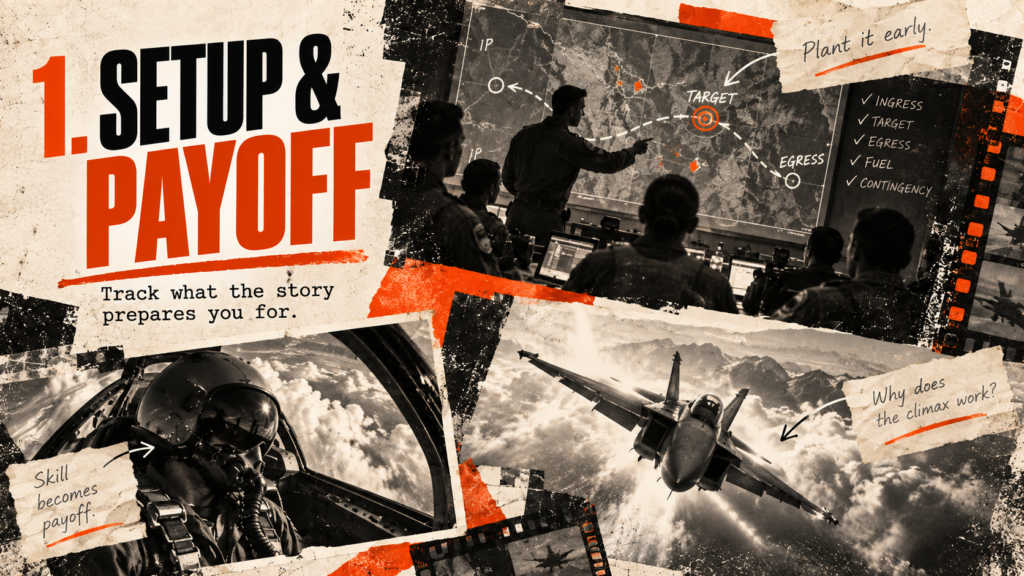
Assignment 1: Study setup and payoff in Top Gun: Maverick
If you want to understand setup and payoff, Top Gun: Maverick is a great place to start. The assignment is simple: watch the film once for enjoyment, then go back and, before the final mission, write down every skill, lesson, rule, warning or small moment that might become important later.
You’re looking for anything the film prepares you for. That might include:
a manoeuvre;
a limitation;
a weakness;
a fear;
a relationship tension;
a piece of training;
a specific danger;
a rule that cannot be broken;
a rule that almost certainly will be broken.
Then watch the final mission and track what pays off.
This is where you start to see how carefully a strong action movie is built. The climax doesn’t just happen. It is prepared. The audience feels the final mission because the story has already taught us what is difficult, what is dangerous, what is almost impossible, and what each character is carrying into that moment.
That’s setup and payoff. Not just planting a random object in act one so it can be used in act three, but training the audience to understand the stakes of the climax before they get there.
As you study, ask which earlier moments become essential later. Which skills are planted before they’re needed? Which fears are tested? Which relationships are paid off? What did the filmmakers prepare you for without you realising it?
That last question is key. The best setups don’t always announce themselves as setups. They feel natural in the moment. Then, later, when they pay off, the audience feels both surprised and satisfied. That’s the magic trick. But it’s a magic trick you can study.
What setup and payoff teaches you
When you study setup and payoff, you start to understand that a climax is only as strong as the preparation behind it. If your ending doesn’t land, the problem may not be the ending itself. It may be that the story didn’t teach us enough earlier.
Maybe we didn’t understand the danger. Maybe we didn’t feel the emotional cost. Maybe we didn’t know what the character had to overcome. Maybe we didn’t see the skill being built. Maybe we didn’t feel the relationship change. Maybe we didn’t recognise the final choice as meaningful.
A good payoff feels inevitable in hindsight. The audience should think, “Of course. That had to happen.” But they shouldn’t necessarily think that too early. That’s the balance.
So when you study a movie like Top Gun: Maverick, don’t just watch the action. Watch the architecture underneath the action. That’s where the screenwriting lesson is.
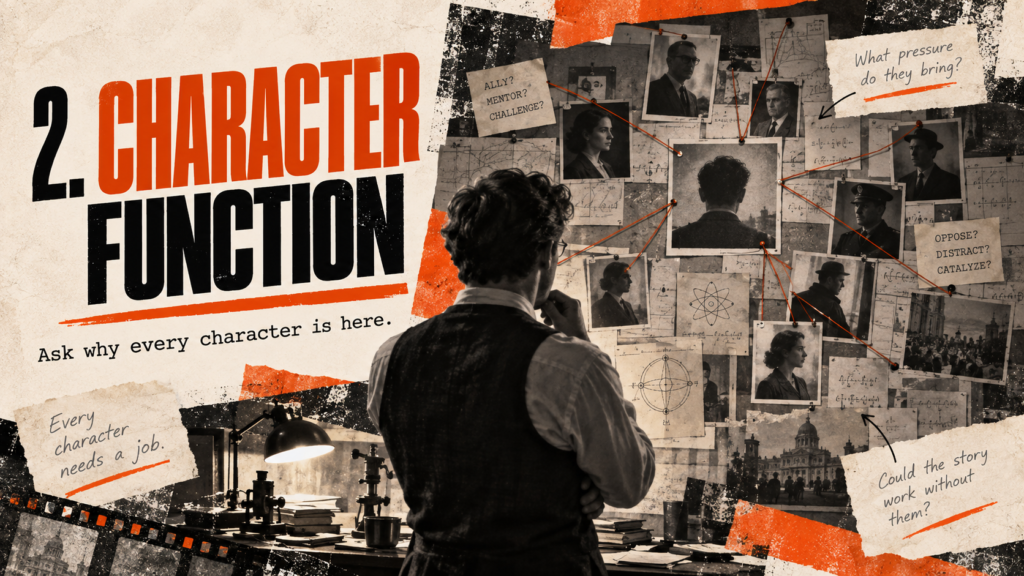
Assignment 2: Study character function in Oppenheimer
Oppenheimer is a very different kind of film, but it’s useful for a different reason: it has a lot of characters. A lot.
So the assignment here is about character function. Watch the first hour and keep a notebook. Every time a new character is introduced, ask:
Why is this person in the story?
What information do they represent?
What pressure do they bring?
How might they affect Oppenheimer later?
Could the story work without them?
This is not about memorising names. It’s about understanding purpose. In a big ensemble story, characters cannot simply exist because the world is busy. They need to serve the story.
Some characters reveal the protagonist. Some challenge them. Some tempt them. Some admire them. Some expose them. Some carry information. Some represent a political, moral or emotional pressure. Some return later in ways that change the meaning of what came before.
Your job as the detective is to work out what each character is doing. Imagine building a murder board. Every character is a suspect. Every scene is a clue. Every connection matters.
Now ask: if I remove this character from the board, what falls apart?
If the answer is nothing, that character may not be necessary. That’s a useful lesson for your own scripts. Writers often keep characters because they like them, because they were in the first draft, or because they solve one tiny plot problem. But if a character doesn’t affect the story, reveal the protagonist, create pressure, carry a theme or change the direction of events, they may be dead weight.
Studying a large film like Oppenheimer helps you see how character function works at scale.
What character function teaches you
Every important character should do a job. That doesn’t mean they should feel mechanical. They still need to feel human, surprising and specific. But underneath that, they should have a reason to exist.
When you look at your own script, ask what each character brings that no one else brings. What pressure do they place on the protagonist? What do they reveal? What would be lost if they disappeared? Could another character do the same job? Are they essential, or are they just present?
That final distinction matters. A script can feel crowded even with a small cast if too many characters lack function. And a script can carry a huge ensemble if every character has a clear dramatic purpose.
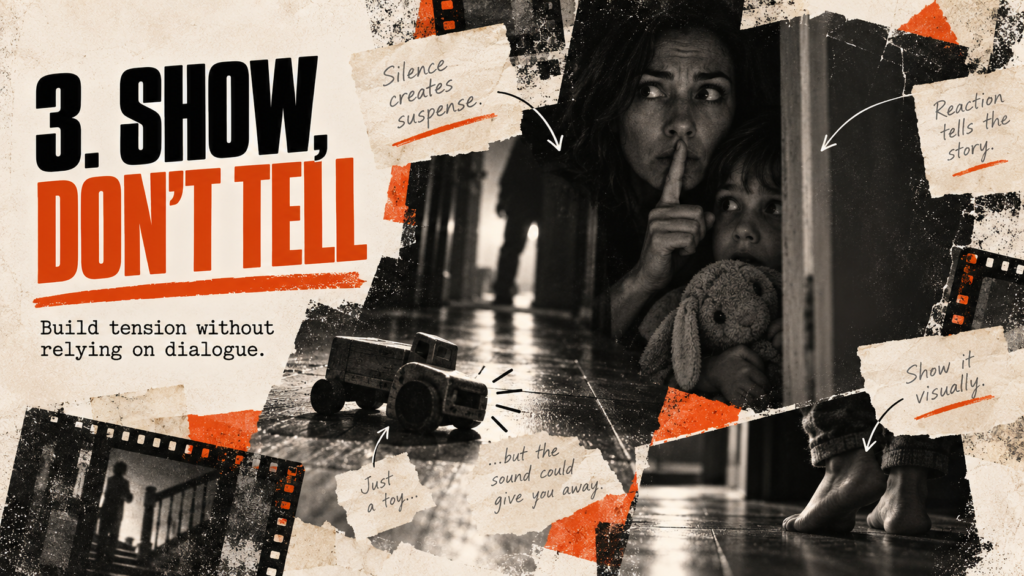
Assignment 3: Study showing vs telling in A Quiet Place
If you struggle with too much dialogue, too much explanation or too much on-the-nose writing, study A Quiet Place. The assignment is to watch how tension is created without relying on dialogue.
Track how often suspense comes from:
silence;
camera movement;
character reaction;
sound design;
visual information;
physical behaviour;
what the characters cannot say.
This film is a masterclass in showing rather than telling because the premise forces the characters into silence. They can’t explain everything out loud, so the story has to work visually.
That’s an incredible lesson for screenwriters. Look at how much we understand through faces, gestures, sounds, objects, movement and fear. Watch how the family communicates without speeches. Watch how danger is created through tiny noises. Watch how the film teaches us the rules of the world through action rather than exposition.
The early sequence with the toy is a perfect example. We understand the world, the danger, the family dynamic and the stakes. And it’s devastating, not because someone explains it, but because we see it.
That is screenwriting.
What A Quiet Place teaches you about visual storytelling
A screenplay is not a novel. You don’t have pages and pages to explain inner life. You don’t get to pause the film and describe every thought. You are writing something that has to be performed, shot, edited, heard and seen.
So ask whether you can show something instead of saying it. Can a reaction carry the meaning? Can a sound create the tension? Can a gesture replace a line? Can the audience understand the rule by watching the consequence? Can silence make the scene stronger?
This doesn’t mean dialogue is bad. Dialogue is one of the great pleasures of screenwriting. But if your script relies on characters constantly explaining what they feel, what they want, what happened, what the rules are and what the scene means, it may not be cinematic enough yet.
Sometimes the strongest line is no line at all.
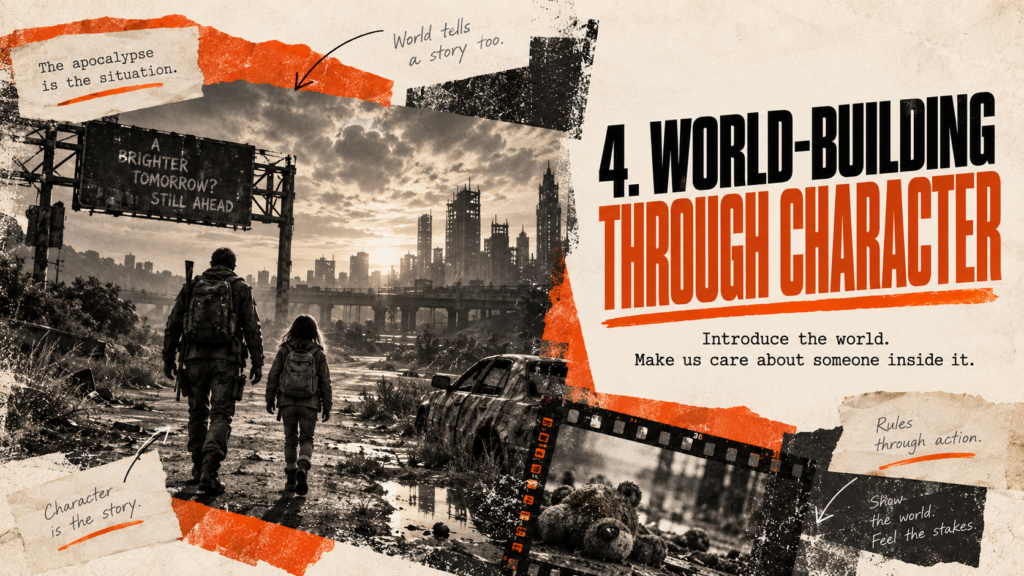
Assignment 4: Study world-building through character in The Last of Us
World-building is tricky, especially in sci-fi, fantasy, horror, dystopian stories, historical worlds or anything with complex rules. The temptation is to explain the history, the infection, the system, the factions, the timeline, the danger, the science, the politics and the rules all at once.
But great world-building does not stop the story to deliver a lecture. It reveals the world through character.
That’s why The Last of Us is such a useful pilot to study. The assignment is to watch the pilot and track how the show introduces its world without stopping the story.
Ask:
What do we learn about the world?
What rules does it have?
What information is revealed through action instead of explanation?
When does the story stop being about the apocalypse and become about the characters?
Why does the episode spend time with Joel before the main story begins?
That last question is especially important. The show is not powerful because of “zombies” or outbreak mechanics alone. It’s powerful because we care about Joel. We understand what he lost. We understand the emotional wound he carries. We understand why the later relationship matters.
The apocalypse is the situation. The character is the story.
What The Last of Us teaches you about pilots
A pilot has to do a lot. It has to introduce the world, the tone, the central character, the emotional hook, the rules, the engine and the reason we should come back. That is a lot of pressure.
The mistake is to think the world itself is enough. It usually isn’t. A massive apocalypse, a strange future, a fantasy kingdom or a high-concept premise may get attention, but character keeps attention.
So when you study The Last of Us, look at how the pilot gives us an emotional reason to care before asking us to invest in the larger story. That’s the lesson: don’t just introduce the world. Make us care about someone inside it.
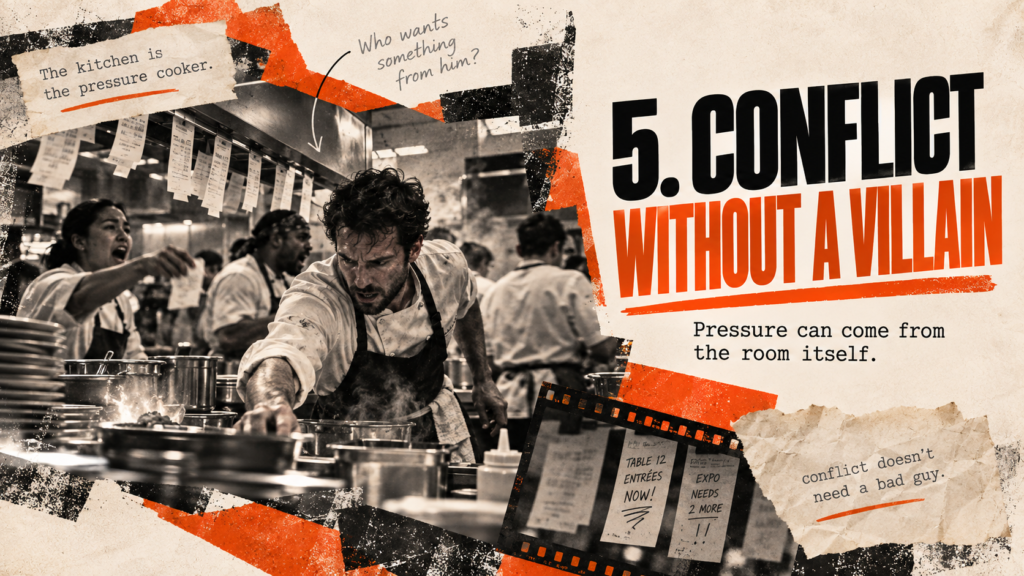
Assignment 5: Study conflict without a villain in The Bear
Not every story needs a villain. But every story needs conflict. That’s why The Bear is such a useful show to study.
The challenge here is to understand how a story can create pressure without a traditional antagonist. Watch the pilot and track every source of pressure placed on Carmy.
Ask:
Who wants something from him?
What problems existed before he arrived?
What problems does he accidentally create?
What does Carmy want?
What does he actually need?
Why is the kitchen chaos effective instead of confusing?
How does the pilot make ordinary situations feel urgent?
How do we understand Carmy’s personality without a traditional backstory?
This is a great exercise because it reminds you that conflict is not always a bad guy plotting in the shadows. Conflict can come from environment: a kitchen, a family business, debt, grief, ego, time pressure, old systems, clashing personalities, unspoken history, professional standards, emotional damage and people who all need different things at the same time.
That’s drama. The antagonist might be the room itself.
What The Bear teaches you about pressure
Pressure reveals character. A calm environment lets people hide. A pressured environment exposes them.
In The Bear, the kitchen is not just a setting. It’s a pressure cooker. It forces everyone’s flaws, habits, wounds and needs to the surface. That’s why the chaos works. It’s not random noise. It’s dramatic pressure.
When you look at your own script, ask where the pressure is coming from. Is it strong enough? Is it specific to this world? Does it reveal character? Does it escalate? Does it force choices? Could the environment itself become a source of antagonism?
Remember: conflict does not require a villain. It requires opposition. Something must push back.
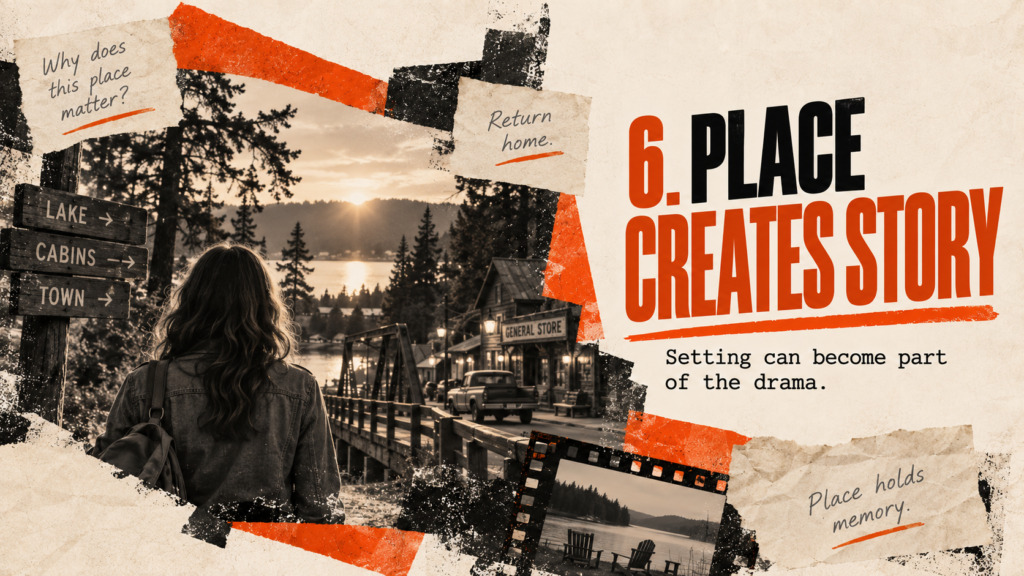
Assignment 6: Study place and emotional connection in Sullivan’s Crossing
Not every story has a giant concept. Some stories work because of character, place and emotional return. That’s where Sullivan’s Crossing becomes useful.
The assignment is to watch the pilot and study how it creates emotional connection through character and setting.
Ask:
What does Maggie want at the beginning of the episode?
What emotional wounds or unresolved issues does she carry?
What does returning to Sullivan’s Crossing force her to confront?
How does the setting influence the story?
How do the writers make us care about Maggie before we fully understand her past?
How does the pilot introduce the idea of confronting who you used to be?
This kind of story often has a familiar setup. A character’s life is disrupted. They are forced back into a world they left behind. Old wounds resurface. Old relationships return. The place they escaped becomes the place they may need.
We’ve seen that shape before, but familiar does not mean weak. The key is emotional specificity. Why did this person leave? Why does this place still have power? What did they become elsewhere? Who were they here? What does coming back force them to face?
The setting is not just a backdrop. It’s a memory, a wound, a temptation and a mirror.
What place can teach you about story
Some locations are just locations. Others are engines.
A town can create story. A kitchen can create story. A hospital can create story. A school can create story. A spaceship can create story. A family home can create story. A campsite can create story.
The question is not just, “Where does this happen?” The better question is, “Why does it have to happen here?”
If the setting could be swapped out without changing the story, it may not be doing enough. But if the place carries history, pressure, community, conflict, memory and emotional meaning, it becomes part of the drama.
That’s what you’re looking for when you study place-led television.
The difference between a premise and a series engine
This is one of the biggest lessons TV can teach screenwriters. A premise is the starting idea. A series engine is what keeps generating story.
A premise might be: a man must transport a girl across a post-apocalyptic America. But the engine is not just the apocalypse. The engine is the relationship, the healing, the danger, the moral choices and the gradual reopening of a man who has shut himself down.
A premise might be: a chef returns to run a chaotic family sandwich shop. But the engine is not just the restaurant. The engine is pressure, grief, ambition, family history, clashing personalities, professional standards and the daily chaos of trying to make something work.
A premise might be: a woman returns to the hometown she left behind. But the engine is not just the return. The engine is unresolved history, community, identity, old wounds, new choices and the question of whether home is a trap or a second chance.
This matters because a lot of pilots have a concept but not an engine. They set up an interesting situation, but by the end, we don’t feel enough future story. A good pilot makes us think, “There are so many places this can go.”
That’s the engine.
Use the detective method on your own script
The real value of this kind of study is that it trains you to look at your own work differently. That’s hard, because writers are too close to their scripts. You know what everything means. You know why the character does that. You know the backstory. You know the setup is supposed to pay off. You know the scene is meant to be emotional.
The reader doesn’t.
The viewer doesn’t.
They only have what’s on the page.
That’s why you need to become a detective with your own script. Take a step back and ask what evidence is actually there. Not what you intended. Not what you know. What’s on the page?
If this were someone else’s script, would the setup be clear? Would the payoff land? Would the character function make sense? Would the world be understandable? Would the conflict feel active? Would the emotional engine be strong enough?
This is one of the hardest skills in screenwriting: learning to see your own work as if you didn’t write it. But the more you practise investigating other films and shows, the better you get at investigating your own.
Build your own story murder board
Try this. Print your script, or open a fresh document, and build a “case file” for your story.
Track:
your protagonist’s want;
their need;
the major setups;
the major payoffs;
each important character’s function;
the sources of conflict;
the emotional wound;
the world rules;
the key unanswered questions;
the turning points;
the final choice;
the series engine, if it’s TV.
Then start pulling pieces away. If you remove a character, what breaks? If you remove a scene, what no longer pays off? If you remove a setup, does the ending still work? If you remove a conflict source, does the story lose pressure?
If nothing changes when you remove something, that thing may not be essential. That’s detective work. You’re not trying to prove your script is perfect. You’re trying to find the truth.
Final checklist: how to study movies and TV like a screenwriter detective
Use these questions after watching a film or pilot you admire.
Setup and payoff
What is planted early? What pays off later? What did the story prepare me for without me noticing? Did the climax use skills, fears, rules or relationships introduced earlier?
Character function
Why is each major character in the story? What pressure do they bring? What information do they carry? What would be lost if they were removed?
Showing vs telling
What is communicated without dialogue? Where does silence create tension? How do reactions, images, sound or behaviour tell the story?
World-building
How does the story teach me the rules of the world? Does exposition stop the story, or is information revealed through action? Why do I care about the people inside this world?
Conflict
Where does pressure come from? Does the story need a villain, or does the environment create enough opposition? What does the protagonist want, and what keeps getting in the way?
Place
How does the setting shape the story? Could this story happen anywhere else? What emotional meaning does the place carry?
TV engine
What makes me want to watch the next episode? What relationships, conflicts or unresolved issues can generate future stories? Is this just a premise, or is there a real engine?
Stop watching passively
If you want to become a better screenwriter, keep watching movies and TV. But don’t only watch. Investigate.
Watch once for pleasure. Then go back with a notebook and a detective’s eye. Study how Top Gun: Maverick sets up its final mission. Study how Oppenheimer uses a huge cast with purpose. Study how A Quiet Place creates tension without relying on dialogue. Study how The Last of Us builds a world through emotional connection. Study how The Bear creates conflict without a traditional villain. Study how Sullivan’s Crossing uses place, memory and return to generate drama.
Then turn the detective work back on your own script. What’s set up? What pays off? Who matters? Where is the pressure? What are you showing? What are you explaining? What engine keeps the story moving?
The more you learn to investigate other people’s work, the more clearly you’ll see your own. That’s how you stop simply consuming stories and start understanding how they’re built.
Need help investigating your own script?
If you’re too close to your screenplay to see what’s working, what’s missing or what isn’t paying off, professional feedback can help.
At Script Reader Pro, your script is read by working writers who understand structure, character, setup, payoff, genre, dialogue and the realities of the industry from the inside out. No automated notes. No generic guesswork. Just human-crafted feedback to help you make the script stronger, one page at a time.
How to Study Movies and TV Like a Screenwriter Detective This blog was created to accompany a recent Script Reader Pro podcast episode, where Scott and Desiree discuss how writers can become “movie and TV detectives” — not just watching films and shows for entertainment, but investigating why they work. In the episode, they break […]
How to Think Like a Screenwriter: Creative Exercises to Train Your Story Brain This blog was created to accompany Script Reader Pro Podcast Episode 74, where Scott and Desiree discuss how to think like a screenwriter — not just by watching movies or reading scripts, but by studying story like a detective. In the episode, […]
The Art of Blank Space: How to Say More by Writing Less This blog was created to accompany Script Reader Pro Podcast Episode 72, where Scott and Desiree discuss “the art of the blank space” — the screenwriting craft of leaving certain things unsaid, unseen or unresolved so the audience has room to participate. You […]