How to Think Like a Screenwriter: Creative Exercises to Train Your Story Brain
This blog was created to accompany Script Reader Pro Podcast Episode 74, where Scott and Desiree discuss how to think like a screenwriter — not just by watching movies or reading scripts, but by studying story like a detective. In the episode, they explore how writers can train their creative instincts through observation, emotional connection, “what if?” thinking, character work, stakes and originality. You can listen to the full episode above, then read on for a practical breakdown of how to start seeing the world the way screenwriters do.
Great screenwriters don’t just have good ideas. They notice more. They notice the person in the coffee shop who keeps checking the door, the couple at the next table who aren’t arguing but definitely aren’t okay, the teenager in pajama pants with the pocket hanging out, the man laughing too loudly at his own joke, or the woman who says she’s fine while gripping her coffee cup like it’s the only thing holding her together.
To most people, those are passing details. To a screenwriter, they’re story.
That’s what it means to think like a screenwriter. It’s not just about formatting a script correctly, knowing where the inciting incident goes, or being able to quote your favourite movies at socially questionable length. It’s about training yourself to see character, conflict, contradiction, emotion and possibility everywhere.
And the good news is that this can be trained. You can build the habit of looking at the world as raw material for story. You can learn to read scripts more actively, watch movies more carefully, observe people more closely and push your ideas beyond the first obvious version. So let’s look at how to start thinking like a screenwriter.
Don’t just watch movies. Study them.
Watching movies is essential for screenwriters, but watching alone is not enough. If you want to get better, you need to study movies and screenplays the way a detective studies a case.
That means looking for clues. Why did that scene start there? Why did it end there? Why was that detail planted earlier? Why did that character react with silence instead of dialogue? Why did the writer choose that image? Why did the emotional beat land? Why did the tension build? Why did the ending feel inevitable but still surprising?
A lot of aspiring writers watch films passively. They enjoy them, quote them, talk about whether they liked them or not, then move on. There’s nothing wrong with that. The first watch should absolutely be for pleasure. Let the film work on you as an audience member. Laugh, cry, get annoyed, get surprised, get swept up in the story.
Then, if the film really works for you, go back. Read the script if you can. Watch the movie again. Compare the two. Look at how the words on the page became images, performances, cuts, sounds and emotional beats on screen. Ask yourself: what did the writer put on the page that made this moment possible?
That’s where the education begins. A screenplay is not just something to read. It’s a textbook. And the best screenwriters keep studying.
Read scripts like a detective
When you read a screenplay, don’t just ask, “Did I like it?” Ask, “How does it work?” That one question changes everything.
A detective doesn’t walk into a room and only notice the body. They notice the glass on the floor, the open window, the mud on the carpet, the missing photo, the strange silence from the neighbour. A screenwriter should read the same way.
You’re looking for setups and payoffs, emotional turns, character contradictions, visual details, pacing shifts, scene entrances and exits, conflict escalation, subtext, tension, surprise, what is said and what is deliberately left unsaid. When a scene works, don’t just admire it. Take it apart.
If a scene makes you feel something, ask how. Was it the dialogue? The situation? The contrast between what someone said and what they meant? The timing? The silence? The visual detail? The way one character wanted something and the other blocked it?
If a scene doesn’t work, ask why. Is it flat? Too obvious? Too slow? Too familiar? Is the character passive? Is the conflict weak? Is the dialogue explaining what the image already tells us?
The goal is not to become cynical. The goal is to become sharper. You want to enjoy movies as a viewer, but understand them as a writer.
Emotional connection is the real test
A screenplay can have a clever concept, a strong structure, a marketable genre and a clean page count, but if we don’t feel anything, it probably won’t stay with us. That’s one of the most important things to understand about screenwriting.
A lot of writers can make us see what they need us to see. Not every writer can make us feel what they need us to feel. That’s the difference.
You can describe a football game, a car chase, a murder investigation, a breakup, a spaceship, a battle, a wedding, a funeral or a monster attack. But unless there’s an emotional reason for us to care, the event itself only goes so far.
Take a sports movie. Most of us know where the genre is heading. There will probably be a big game. Someone will get injured. Someone will make a mistake. Someone will need to prove themselves. The underdog team may get their shot. But the reason we care is not the game itself. We care because of the person playing it.
We care because the story has made the game mean something emotionally. Maybe the character is trying to win their father’s approval. Maybe they’re trying to escape a dead-end town. Maybe they’re trying to prove they’re not broken. Maybe they’re trying to do one good thing before they lose everything.
That’s what you’re looking for when you study a script. Not just what happens, but why it matters.
Learn to pace emotion
Emotional connection does not mean every scene should be heavy. In fact, if every scene is emotionally intense, the audience eventually stops feeling it. A story needs movement. Heavy scenes need lighter scenes. Tension needs release. Sadness needs breath. Drama needs rhythm. Even the darkest story usually benefits from moments of humour, tenderness, absurdity or relief.
This is part of thinking like a screenwriter. You’re not just asking, “Is this scene emotional?” You’re asking, “Where does this emotion sit in the flow of the whole story?”
If five scenes in a row are all operating at the same emotional pitch, something may start to flatten. Even if each scene is individually strong, the sequence can become exhausting. A good script knows when to squeeze and when to release. It knows when to hold tension and when to let the audience breathe.
It also knows that a joke in the middle of a painful scene can sometimes make the pain hit harder, because that’s how life works. People crack jokes at funerals. They say stupid things when they’re scared. They laugh in hospital waiting rooms. They avoid the real subject until they can’t anymore.
Emotional pacing is not about making the story neat. It’s about making it human.
Build tension by withholding
Tension often comes from what the audience doesn’t know yet. If you tell the audience everything immediately, there’s no reason to lean in. But if you give them enough to understand the emotional direction of the scene while holding back key information, they become active. They start asking questions.
What happened before this scene? Why won’t she answer the phone? Why did he lie about where he was? Why is that door locked? Why did that character pause before saying yes? Why does everyone in the room know something the protagonist doesn’t?
That kind of tension keeps the audience engaged. It’s not about being confusing. It’s about giving the audience something to solve, feel or anticipate.
Screenwriters need to think in terms of curiosity. What question is this scene creating? What question is this sequence answering? What question is the audience carrying into the next scene?
When you start thinking this way, scenes become less about delivering information and more about creating momentum.
Conflict reveals character
Conflict is not just people shouting at each other. Conflict is pressure. It is the moment when a character wants something and something or someone gets in the way.
That obstacle might be another person. It might be society. It might be the weather. It might be money. It might be fear. It might be guilt. It might be the character’s own flaw. But without pressure, character often stays hidden.
A person can say they are brave. Put them in danger. A person can say they are generous. Make generosity cost them. A person can say they are loyal. Tempt them to betray someone. A person can say they have changed. Put them in a situation where the old behaviour would be easier.
That’s how screenwriters think. They don’t just ask, “Who is this person?” They ask, “What situation would reveal who this person really is?”
Conflict gives character a chance to become visible. And that’s why it matters.
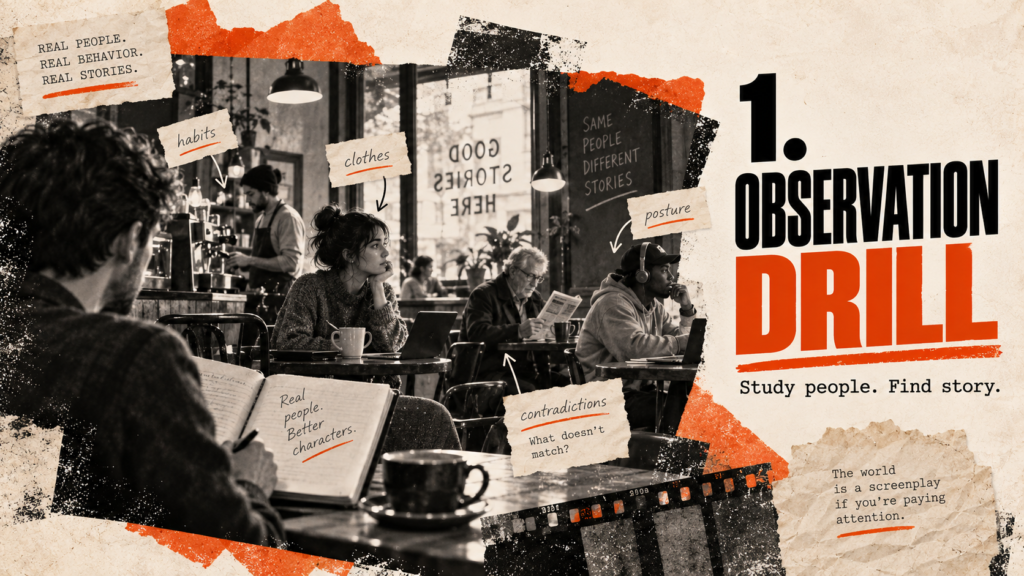
Exercise 1: The observation drill
One of the simplest ways to train your story brain is to go somewhere public and observe. A coffee shop, train station, park, waiting room or supermarket cafe will do. Anywhere people gather is useful.
Spend five minutes actually looking. Not scrolling, not checking emails, not half-watching while thinking about something else. Pick five people and write down details: their habits, clothes, posture, energy, contradictions, who they’re with, what they’re doing with their hands, whether they seem rushed, relaxed, anxious, lonely, distracted or pleased with themselves.
The important thing is not just to describe them visually. Start asking story questions. Why did they choose those clothes? Why do they keep checking their phone? Why are they sitting alone but looking at the door every thirty seconds? Why does that couple look like they’ve run out of things to say? Why does that person seem completely at home in this room? Why does that person seem like they want to disappear?
The point is not to judge people. Though, let’s be honest, writers are often professionally curious with a side order of judgement. The point is to notice.
Screenwriting begins with attention. The more specific your observations, the more specific your characters become.
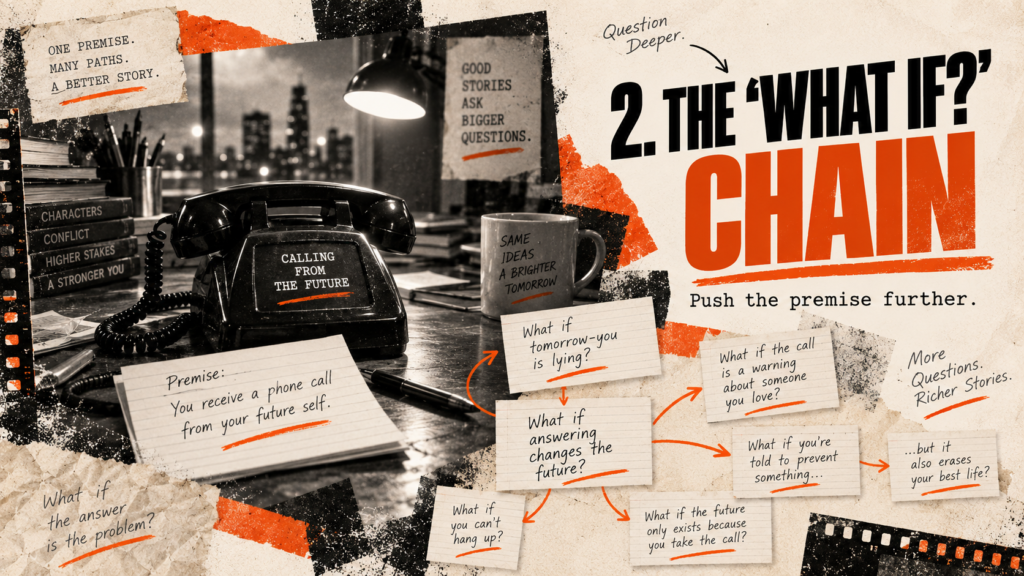
Exercise 2: The “what if?” chain
Most story ideas begin with a “what if?” What if a boy discovered he was a wizard? What if a shark terrorised a beach town? What if a man could enter people’s dreams? What if a teenager accidentally travelled back in time and met his parents?
But the first “what if?” is only the beginning. The real work is in the chain.
Take a simple idea: what if your phone rang and it was yourself calling from tomorrow? That’s interesting enough to begin with, but don’t stop there. What if tomorrow-you was lying? What if answering the call changed the future? What if the call was not a warning, but a trap? What if tomorrow-you needed you to do something terrible today? What if you ignored the call and the thing still happened? What if someone else answered your phone? What if tomorrow-you was trying to stop you becoming them?
Every new question opens another door. This is how ideas become stories.
Too many writers stop at the first interesting premise. But the first idea is often the most obvious version. Push further. Ask ten more questions. Twelve more. Twenty more. Somewhere down the chain, you may find the twist, the emotional hook, the antagonist, the moral dilemma or the ending.
The screenwriter’s brain is trained to keep asking: and then what? But why? But what if?
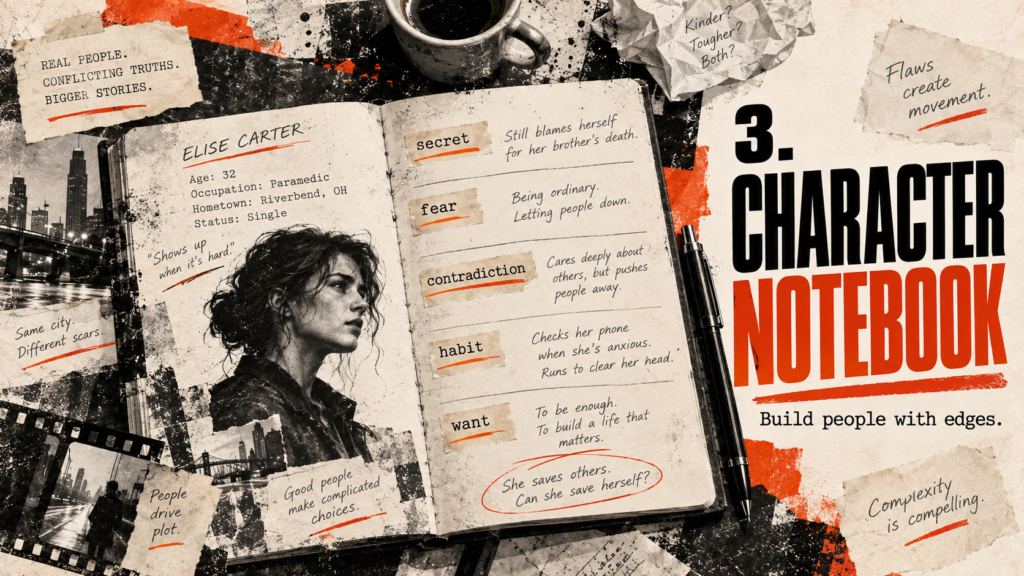
Exercise 3: Keep a character notebook
Create one new character every day. Not a full biography. Not a ten-page backstory. Just enough to make them feel alive.
Give them a name, a secret, a fear, a contradiction, a strange habit and something they desperately want. The contradiction is especially useful because characters become interesting when they don’t quite add up.
A pastor who is secretly cruel. A hitman who is terrified of confrontation. A billionaire who steals hotel shampoo. A children’s entertainer who hates children. A therapist who cannot be honest with their own family. A fitness influencer who smokes in secret. A police officer who faints at the sight of blood.
Contradiction creates dimension because real people are contradictory. We all are. We say we value honesty, then avoid the difficult conversation. We say we don’t care what people think, then check who liked the post. We say we want change, then resist it the second it arrives.
Your characters should have that same friction. A character notebook helps you collect these fragments before you need them. One day, a detail you wrote down months ago may unlock a scene, a supporting character or an entire script.
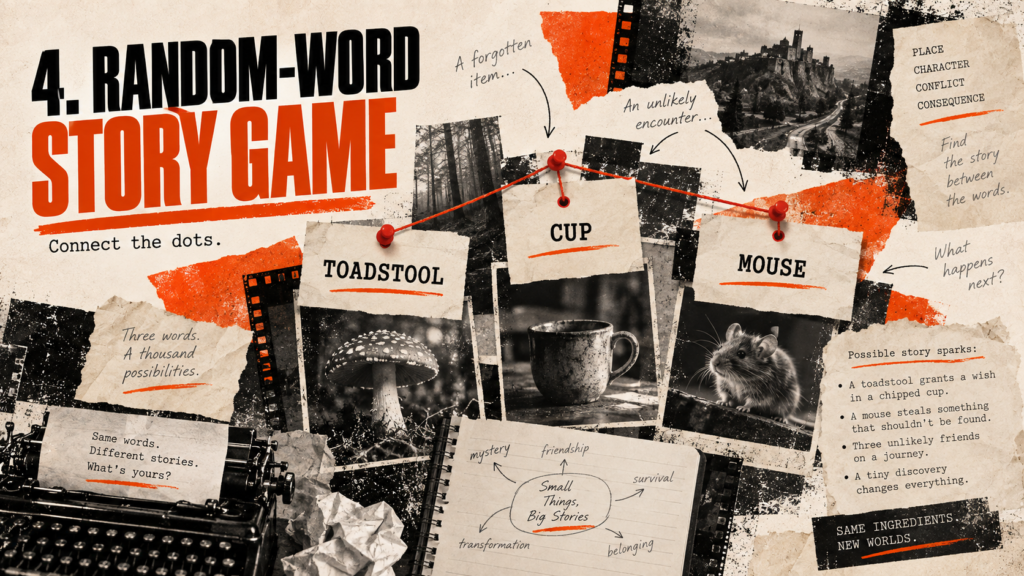
Exercise 4: The random-word story game
Pick three random words. Any three. For example: toadstool, cup and mouse.
Now force yourself to connect them into a story. It probably won’t be good. That’s fine. The point is not to produce a masterpiece. The point is to train your brain to make connections quickly.
Screenwriting often involves taking unrelated pieces and finding the story between them: a location, a character, a prop, a fear, a line of dialogue, a contradiction, a memory, a news story, a visual image. Your job is to connect.
The random-word game builds that muscle. You can do it alone, with a friend, in a writers’ room, or as a warm-up before working on your script. Try giving yourself two minutes. No overthinking. No editing. No worrying whether the idea is sensible. Just connect the dots.
The faster you practise making connections, the more agile your story brain becomes.
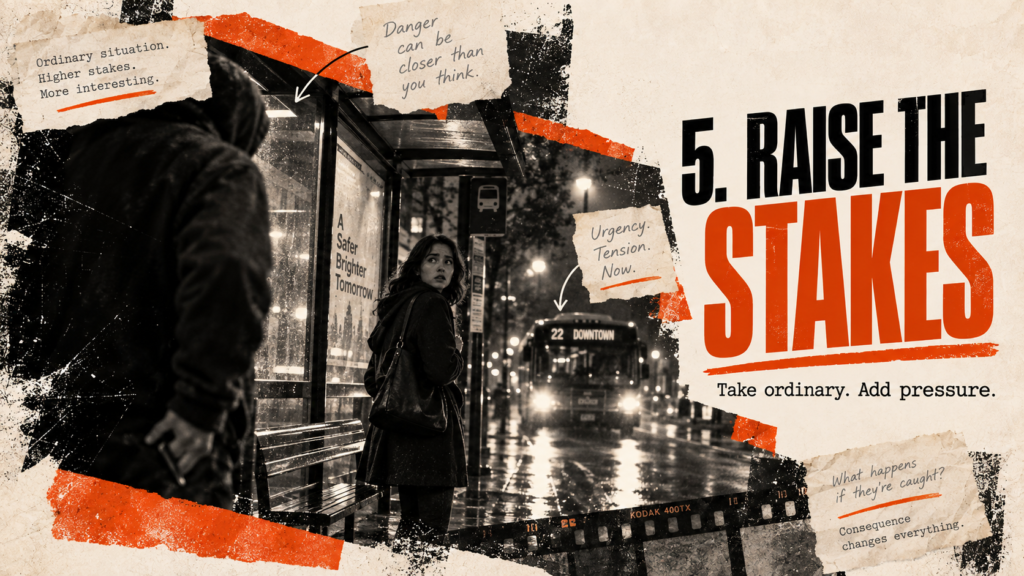
Exercise 5: Raise the stakes
Take a boring situation. Someone waiting for a bus. Someone sitting in a cafe. Someone walking a dog. Someone buying milk. Someone standing in a lift. Someone writing in a notebook.
Now add pressure.
What if the person waiting for the bus is being followed? What if they only have enough money for one journey? What if there’s a gun in their pocket? What if they’re on their way to meet someone who betrayed them? What if the bus is late, and every minute matters? What if the person following them gets on the bus too?
Suddenly, a mundane scene has tension. The situation hasn’t changed much on the surface. Someone is still waiting for a bus. But now there is danger, secrecy, urgency and consequence.
That’s stakes.
Not every scene needs a gun, of course. Stakes can be emotional, romantic, professional, moral, social or internal. But something has to matter. A scene becomes more interesting when the audience understands what can be gained, lost, revealed, damaged or changed.
Screenwriters are always looking for ways to make ordinary situations carry dramatic weight.
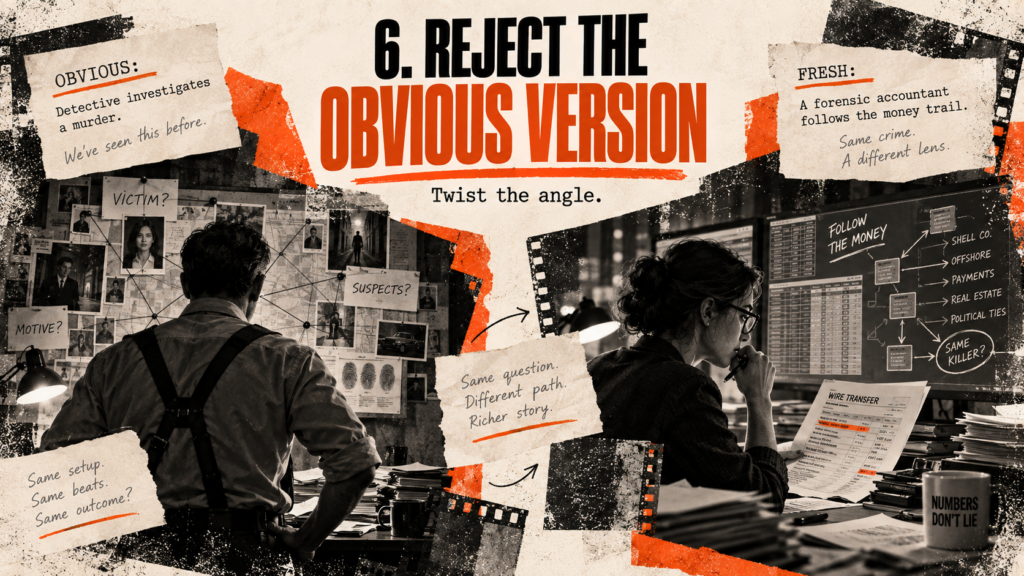
Exercise 6: Reject the obvious version
Originality often begins when you identify the obvious version of an idea and deliberately reject it.
Start with a familiar premise: a detective investigates a murder. That’s fine, but we’ve seen it many times. So ask: what’s a less obvious version? Maybe a forensic accountant investigates a murder by following a trail through tax records. Now the angle feels fresher.
Try another. A child is suspected of murdering their parents. Again, potentially interesting, but still familiar. Push it. What if the child insists their imaginary friend did it? What if the imaginary friend may actually exist? What if the child is lying? What if the imaginary friend is a split personality? What if the investigator starts seeing the imaginary friend too?
Now you have more mystery, ambiguity and tension. The goal is not to make everything bizarre for the sake of it. The goal is to avoid stopping at the first version of the idea.
The first version is often the version everyone else thought of too. A screenwriter keeps digging.
How to study a scene properly
The exercises above will help you generate ideas, but you also need to train yourself to study craft. Pick a scene from a great screenplay and ask what each character wants in that scene. Not generally, not across the whole movie, but right there in that moment. What are they trying to get, avoid, hide, prove, protect or force?
Then ask where the conflict is. Is it external, internal, emotional, social, physical or moral? Does one character’s goal block another’s? Is there real pressure in the scene, or are people simply exchanging information?
After that, ask what changes by the end of the scene. A scene should usually turn. Someone learns something, loses something, gains something, decides something, hides something, reveals something, gets closer or pulls away. If nothing changes, why is the scene there?
Then look at the emotional effect. What are we meant to feel? Suspicion? Hope? Dread? Relief? Desire? Anger? Embarrassment? Grief? And how does the scene create that feeling?
Finally, look at what is being set up and what is being paid off. Is there a line, object, decision, wound, relationship or piece of information that will matter later? Did something from earlier return in a new way? What is left unsaid? What are the characters not saying, and what does the audience understand anyway?
This kind of study is how you sharpen your instincts. You are not just reading. You are reverse-engineering.
How to introduce a character like a screenwriter
The episode’s Q&A also touches on a common beginner mistake: overwriting a character introduction. New writers often want to tell us everything. They introduce someone with a block of description that includes personality traits, backstory, emotional tendencies and information the audience could never actually see.
Something like: “Sarah, 32, enters. She is funny, guarded, secretly lonely, bad at trusting people and still haunted by her relationship with her father.”
Some of that may be true, but it isn’t playable yet. In a screenplay, we need what can be shown.
So instead of telling us Sarah is guarded, show us behaviour. Maybe she enters a party, clocks every exit, smiles at no one and keeps her coat on. Instead of telling us she is funny, give her a funny line. Instead of telling us she doesn’t trust people, show her turning her phone face down when someone sits beside her. Instead of telling us she is lonely, show her returning home, ignoring three messages, then listening to an old voicemail she refuses to delete.
That’s thinking like a screenwriter. Don’t explain the character. Dramatise them.
The biggest misconception new screenwriters have
Another useful point from the Q&A is the myth that breaking into the industry happens quickly. A new writer imagines they’ll write a script, send it to a couple of people, get a call the next day and suddenly everyone in Hollywood is fighting over it.
That is not how this usually works.
Most writers write for years. They finish scripts that don’t work. They improve. They get notes. They rewrite. They write new scripts. They make connections. They submit. They get rejected. They keep going.
This matters because thinking like a screenwriter also means thinking like someone building a craft over time. One script is not the whole career. One idea is not the whole identity. One rejection is not the final verdict.
The work is the work. And the more seriously you study, observe, practise and rewrite, the better your chances become.
Are you rewriting or just procrastinating?
There’s also a difference between rewriting and endlessly tweaking. Rewriting changes the script. Tweaking changes a few words while letting you avoid the harder questions.
If you’re unsure which one you’re doing, compare drafts. Has the story changed? Have scenes been restructured? Has the character arc deepened? Has the conflict sharpened? Has the ending improved? Has the pacing changed? Or have you just swapped a line here, trimmed a sentence there and adjusted punctuation while avoiding the bigger issue?
At a certain point, you have to stop polishing and move forward. That might mean sending the script out for feedback. It might mean starting the next script. It might mean accepting that this is the best version you can write right now.
Professional writers do not become professional by endlessly tinkering with one script forever. They keep writing.
Representation or connections?
Writers often ask whether they should focus on getting representation or building industry connections. The honest answer is that both matter, but neither matters much without a strong script.
A connection may get someone to open the door. A manager may help get your work in front of the right people. A recommendation may create an opportunity. But the writing has to hold the room.
So yes, build relationships. Reach out thoughtfully. Pay attention to the people making the kind of work you love. Be generous. Be curious. Be professional. But don’t use networking as a substitute for craft.
The best thing you can do for your career is write something good enough that people want to keep talking about it after they read it.
Final checklist: are you thinking like a screenwriter?
When you watch a movie, read a script or work on your own idea, ask what the emotional hook is and why we care about this character. Look at what each scene changes, where the conflict comes from, what is being set up, what is being paid off, and what the audience is being invited to feel.
Ask what is being withheld, what the obvious version of the idea is, how the perspective could be fresher, what specific behaviour reveals character, what detail could make this person feel real, and where the stakes could be raised.
Most importantly, ask whether you are watching passively or studying actively. Are you only consuming the story, or are you learning how it works?
Because screenwriting is not just about plot mechanics. It is about emotional experience. You are not writing a document to be admired for its formatting. You are writing a blueprint for a movie or TV show that should move, entertain, surprise and engage an audience.
So train your brain. Read scripts. Watch films twice. Observe strangers. Collect characters. Play with “what if?” Reject the obvious. Raise the stakes. Study emotion. And keep asking the question every serious screenwriter has to ask:
How do I make the audience feel this?
Need help developing your story instincts?
If your idea feels thin, your characters aren’t landing, or your script isn’t creating the emotional response you hoped for, professional feedback can help you see what’s really on the page.
At Script Reader Pro, your script is read by working writers who understand story, structure, character and the realities of the industry from the inside out. No automated notes. No generic guesswork. Just human-crafted feedback to help you make the script stronger, one page at a time.
How to Study Movies and TV Like a Screenwriter Detective This blog was created to accompany a recent Script Reader Pro podcast episode, where Scott and Desiree discuss how writers can become “movie and TV detectives” — not just watching films and shows for entertainment, but investigating why they work. In the episode, they break […]
How to Think Like a Screenwriter: Creative Exercises to Train Your Story Brain This blog was created to accompany Script Reader Pro Podcast Episode 74, where Scott and Desiree discuss how to think like a screenwriter — not just by watching movies or reading scripts, but by studying story like a detective. In the episode, […]
The Art of Blank Space: How to Say More by Writing Less This blog was created to accompany Script Reader Pro Podcast Episode 72, where Scott and Desiree discuss “the art of the blank space” — the screenwriting craft of leaving certain things unsaid, unseen or unresolved so the audience has room to participate. You […]